
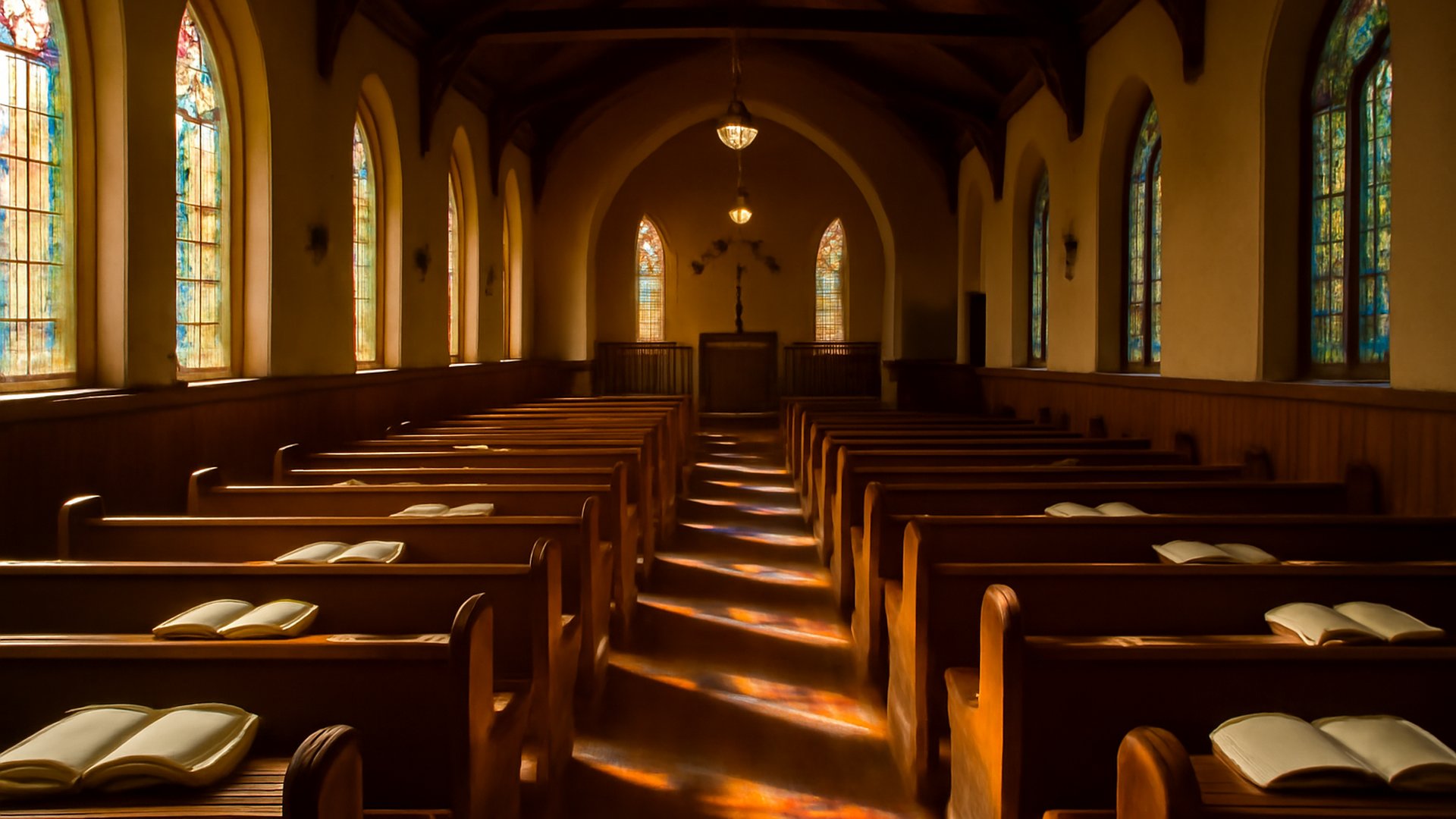
Most people now carry a device that can play a sermon, stream a worship service, and deliver a daily devotional, all without leaving the couch. So why does the local church keep insisting that believers gather, in person, on Sunday mornings?
The answer is older than the internet, deeper than tradition, and surprisingly hard to replicate at home. After five years of pastoring a congregation that ran a high-quality livestream alongside in-person services, I am more convinced than ever that gathered worship is not interchangeable with watching gathered worship. The two are related, but they are not the same thing.
This article explains why, what the post-pandemic data actually shows, and how to think about livestream and hybrid worship without either canonizing or condemning them.
More Than a Habit
Sunday worship is the oldest continuous Christian practice. Long before doctrines were codified, believers were already gathering on the first day of the week to break bread, pray, sing, and hear scripture read aloud. The shape of the gathering has varied across centuries, but its existence has not.
A practice that survives two thousand years of war, persecution, migration, and reform is doing something the participants find indispensable. Calling that habit is too small a word.
What Hebrews 10:24–25 Actually Asks of Us
Hebrews 10:24–25 is one of the few New Testament passages that addresses gathered worship directly: let us consider how to stir up one another to love and good works, not neglecting to meet together, as is the habit of some, but encouraging one another. The verse is often quoted as a guilt mechanism for irregular attenders. It deserves a more careful reading.
The instruction is plural. It assumes a community responsibility, not just an individual one. The author is worried not primarily about Sunday attendance numbers but about believers losing the regular human contact that makes endurance possible. Reading the passage at the level of individual obligation misses how communal the original concern was.
What the Post-COVID Data Actually Shows
The pandemic years produced unusually clean data on what happens when in-person worship becomes optional. The findings, summarized in surveys by Lifeway Research and Barna, are consistent.
- Roughly 80% of pre-pandemic regular attenders returned in person by 2024.
- About 15% shifted to a livestream-only pattern.
- Around 5% stopped attending in any form.
- Livestream-only attenders reported sharp declines in giving, volunteering, and forming friendships with other congregants.
- Hybrid attenders — people who used livestream selectively but attended in person at least twice a month — reported levels of engagement similar to pre-pandemic regulars.
The pattern is not that livestream destroys engagement. It is that livestream-as-default does. Used as a supplement, it is largely neutral or positive. Used as a replacement, it correlates with measurable disengagement over twelve to eighteen months.
Embodied Presence and the Sacraments
Streaming is a remarkable gift to the homebound, the hospitalized, the traveling, and the curious. It is not, by itself, a substitute for the gathered church.
Worship is sung together, communion is taken together, peace is passed together, baptisms are witnessed together. Each of these moments depends on bodies in a room. Sacramental theology across traditions, Catholic, Orthodox, Lutheran, Reformed, and Anglican alike, treats the gathered eucharistic assembly as the irreducible center of Christian worship. Even traditions with low sacramental theology treat congregational singing and the audible amen as practices the screen flattens.
Accountability, Care, and Being Missed
Showing up regularly to the same place creates the conditions for being missed. Pastors, deacons, and ordinary congregants notice when someone is absent two weeks in a row, and that noticing has, for generations, been an early warning system for grief, illness, isolation, and crisis.
Livestream attendance is harder to track and harder to follow up on. A regular attender who slips into watching online for a season often disappears from view of the pastoral care system entirely. The next time their name surfaces, it is in a much harder conversation.
Formation Through Repetition
Spiritual habits are formed by repetition. Reading scripture aloud, confessing together, singing the same psalms, and saying the same prayers over the years shapes the inner life in ways that variety alone cannot. The Sunday gathering is the engine room for that formation.
The personalized internet is structurally hostile to this kind of slow, repetitive formation. Algorithms reward novelty. Liturgy rewards return. A believer formed primarily by recommended content develops a different kind of inner life than one formed primarily by repeated congregational practice.
Intergenerational Connection
A healthy congregation puts children, teenagers, parents, single adults, and elders in the same room every week. There are very few other places left in modern life where this happens. The unscripted friendships across generations that emerge from this pattern are some of the most quietly powerful experiences of church.
Online church is, by structural necessity, age-segmented. The kids are watching cartoons in the next room while the adults watch the sermon. The teenagers are upstairs. The grandparents are in their own house entirely. The integration that the gathered assembly produces does not happen automatically when the assembly is virtual.
A Counterculture of Slowness
Sunday worship is, deliberately, slower than the surrounding culture. There is silence, repetition, and waiting. For many congregants, the hour each week is the only time they are not multitasking. That alone is a gift.
A streamed service in a kitchen, surrounded by dishes and a phone, will inherit the speed of the room it is in. Even with the best intentions, sustained spiritual attention is hard to manufacture on a couch.
When Livestream Is Genuinely Good
A balanced view recognizes that livestream is a real ministry tool, not a temptation to be resisted. Several genuine goods come with it.
- It serves the genuinely homebound, the post-surgical, and the immunocompromised who cannot attend in person.
- It allows a curious neighbor to listen to a sermon before risking an in-person visit.
- It keeps distant family members connected to baptisms, weddings, and funerals.
- It supports travelers, military families, and missionaries on the move.
- It enables the chronically ill, the deeply anxious, and the recently bereaved to keep one foot in the community during seasons when in-person attendance is impossible.
What About the Homebound, Disabled, and Traveling?
A theology of gathered worship that shames the people who cannot attend in person is a theology that has misunderstood itself. The biblical category for the homebound is not spiritually lesser. It is worthy of pastoral visitation.
The pastoral move is to combine livestream with home communion, in-person visitation, and intentional small-group connection. The screen is a supplement to a richer pastoral relationship, not a replacement for it. A homebound believer who receives weekly streamed worship plus monthly home visits is more connected than one who watches alone and is never seen.
Hybrid Worship Done Well
The congregations that are navigating the post-pandemic landscape with the most integrity tend to follow a similar pattern. They keep the livestream. They are honest with their people about what livestream cannot deliver. They build infrastructure for follow-up with online attenders. And they treat in-person attendance as the normative practice for the able-bodied, without using guilt as the recruiting mechanism.
In practical terms, that often means publishing a clear pastoral statement on what livestream is for, sending periodic notes from a deacon to regular online viewers, and using small groups as the connective tissue that prevents online attenders from drifting into invisibility.
Frequently Asked Questions
Is online church biblical?
There is no New Testament category for streaming, so the question is asking what the biblical principles of gathered worship imply when applied to new media. Most traditions answer that online participation can be genuine participation, especially for the homebound, but that the able-bodied believer is meant to be gathered with the congregation when possible. The screen is a supplement, not a substitute.
Does watching church online count as attending church?
It depends on what is meant by counts. As an act of devotion and attention, yes. As a substitute for the gathered assembly, no. The clearest pastoral framing is that livestream is real worship but it is not full worship, in the same way that praying alone is real prayer but it is not the same as praying with the church.
How often should Christians attend church?
The biblical and historical pattern is weekly. The early church gathered on the Lord's Day (Sunday) every week, and that pattern has continued across nearly every Christian tradition. Less frequent attendance is common in practice, but the formative payoff of weekly gathering is significantly higher than monthly attendance.
Why do some churches still livestream after the pandemic?
Because for many congregations the livestream is reaching genuinely homebound members, distant family, and curious neighbors who would not otherwise be reached. The mistake is treating it as a replacement for in-person worship for healthy adults rather than as a ministry to specific groups.
What does the Bible say about gathering together?
Hebrews 10:24–25 is the most direct passage, urging believers not to neglect meeting together. Acts 2 describes the early church meeting daily. The Psalms repeatedly celebrate gathered worship. The consistent biblical assumption is that worship is plural and embodied, even when individual prayer is also valued.
Can I just watch a great preacher online instead of attending my local church?
Watching famous preachers online and skipping the local church is one of the most common patterns clergy report. It produces inflated theological vocabulary alongside very thin spiritual roots. The local congregation is harder, slower, and less polished, and that is part of why it forms people that a podcast cannot.
What if my local church is unhealthy?
That is a real situation that deserves more than this article can offer. A short answer is that finding a different local congregation is almost always the right next step, and that staying alone with a podcast is rarely a sustainable path. Reach out to a pastor you trust outside your current church for guidance.
Conclusion
Hyperconnectivity has not made gathered worship obsolete. It has made it more obviously necessary. The local Sunday service is one of the few places where presence is the point, where the body matters, and where the soul is given permission to rest.
If you have drifted into livestream-as-default, this is a gentle invitation to return. If you cannot return, this is a reminder that the church is supposed to come to you. Either way, the gathering itself is older, deeper, and more durable than any technology that has tried to replace it. That is a reason to keep showing up, and a reason to make sure the door is open for the people on the other end of the livestream.
You might also be interested in the following: